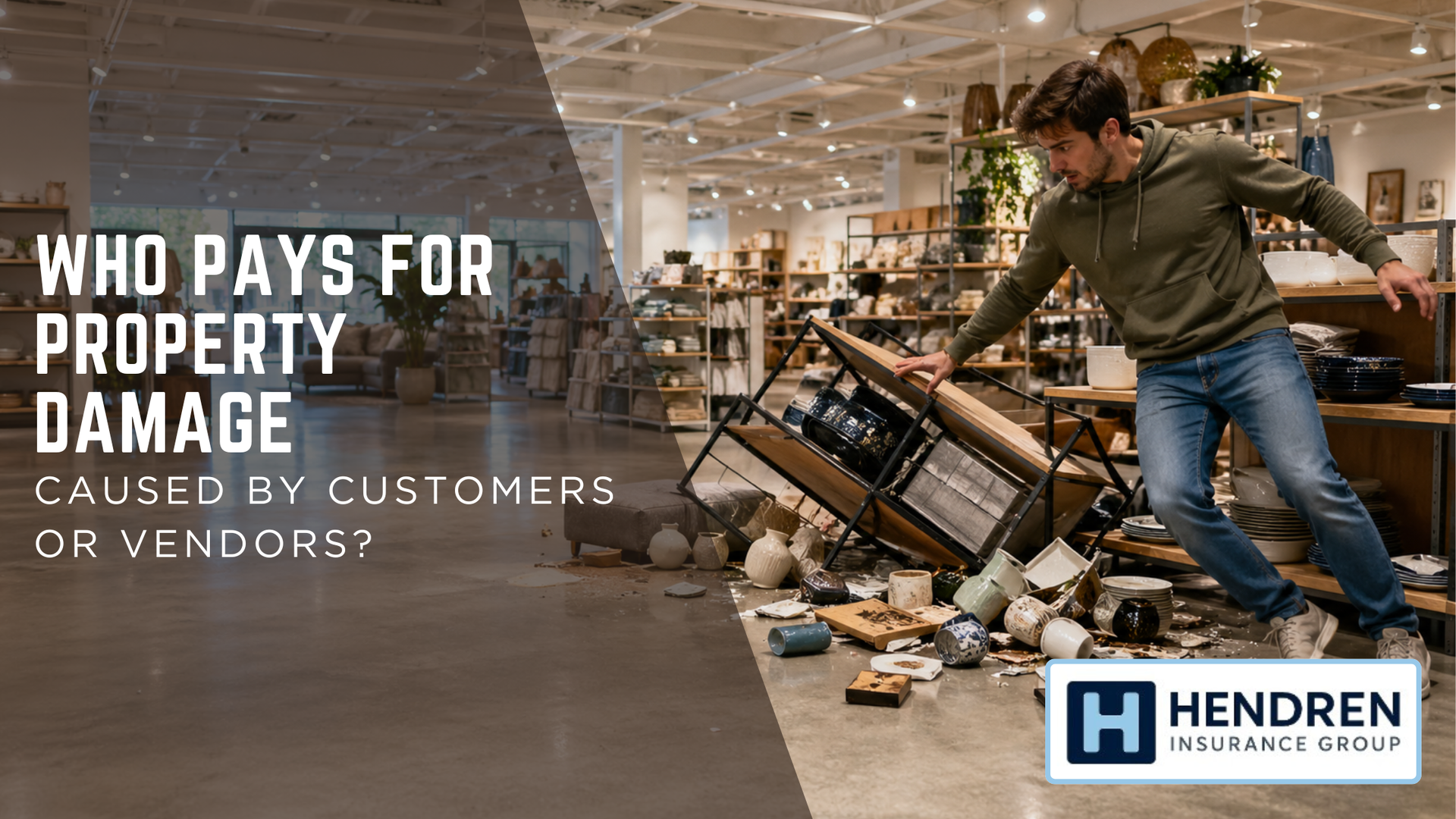
Who Pays For Property Damage Caused By Customers Or Vendors?
April 26, 2026

Property damage caused by customers or vendors is not always paid by the same policy, because the answer depends on who caused the damage, what kind of property was damaged, and whether liability can be established. In many cases, the responsible party’s liability insurance may apply, but your own commercial property or business policy may still become part of the recovery process depending on the situation.


Why This Question Is More Complicated Than It Sounds

When business property is damaged, many owners naturally want a simple answer about who pays. The problem is that “customers” and “vendors” can create very different insurance situations. A customer might accidentally damage a display, door, fixture, or piece of equipment while on the premises. A vendor might damage a loading area, business personal property, or part of the building while delivering goods, performing work, or using equipment on site.


A common issue we see is a business owner assuming the person who caused the damage will automatically pay directly, or that the responsible party’s insurance will handle everything quickly without dispute. In reality, the process is often more layered than that. The facts of the event, the contracts in place, the condition of the damaged property, and the available insurance coverage all matter.


In Owasso, OK, this becomes especially important for retail businesses, offices, service locations, and commercial properties where customers, delivery drivers, maintenance vendors, and outside contractors move through the premises regularly.


The First Question Is Usually: Who Was Actually Responsible

Before insurance gets sorted out, liability usually has to be evaluated. That means determining whether the damage was actually caused by the customer or vendor, whether negligence was involved, and whether the business itself may share any responsibility.

For example, if a delivery vendor backs into a storefront column, liability may appear straightforward. If a customer trips into a display after walking through a cluttered area, the situation may be less clear. If a vendor damages equipment while following unclear instructions from staff, there may be a dispute about who was truly responsible.


This matters because insurance does not usually start with the question, “Was something damaged?” It starts with, “How did it happen, and who is legally responsible for paying?” That is why incident details, witness accounts, photos, and documentation are so important.


When The Other Party’s Liability Insurance May Apply

If a customer or vendor is legally responsible for damaging your property, their liability coverage may be the policy that responds. For a vendor, this may be a commercial general liability policy, commercial auto policy, or another business insurance policy depending on how the damage occurred. For an individual customer, personal liability coverage under a homeowners, renters, or umbrella policy might become relevant in some situations.


This often applies when the damage was caused by:

  • A vendor’s employee operating a vehicle or equipment
  • A service provider damaging property while performing work
  • A customer acting negligently and damaging business property
  • A third party causing direct accidental damage that can be tied to their actions


In our work with clients, one of the most common misunderstandings is assuming that because someone else caused the damage, their insurer will automatically accept fault right away. That is not always what happens. Their carrier may investigate, question liability, or dispute the value of the claim before agreeing to pay.


Your Own Property Insurance May Still Matter

Even if another party appears responsible, your own commercial property insurance may still play an important role. This is especially true when the damage needs to be repaired quickly and waiting for the other party’s carrier could slow down business operations.


For example, if a vendor damages a glass entry, specialized equipment, cabinetry, or fixtures, your business may not be able to wait weeks or months for a liability decision before making repairs. In that case, your own property insurance may help you move forward faster if the loss falls within your coverage. Your insurer may then pursue recovery from the responsible party’s insurance through subrogation.


A common issue we see is a business owner feeling like using their own policy means they are somehow accepting fault. That is not usually what it means. It may simply be the faster route to get the property repaired while the insurers sort out who ultimately bears the cost.


Around Bailey Ranch or near Centennial Park, many businesses depend on uninterrupted access, safe customer areas, and functioning equipment, so delay itself can become a business problem even when liability seems clear.


Customers And Vendors Create Different Risk Profiles

It helps to separate customers from vendors because the insurance analysis is often different.

Customers are usually on the premises for shorter, less controlled interactions. Their individual liability coverage may exist, but many customers do not know what personal liability protection they carry, and smaller property damage incidents may not lead to formal claims easily.


Vendors are different because they are often businesses themselves. They may have:

  • Commercial general liability coverage
  • Commercial auto insurance
  • Inland marine or equipment coverage
  • Contractual obligations to indemnify your business
  • Certificates of insurance on file


This is why vendor-caused damage is often easier to frame as a business-to-business claim, while customer-caused damage can be more unpredictable. A common issue we see is that businesses have strong vendor insurance requirements on paper, but no one has actually reviewed the certificate, contract language, or indemnity clause recently enough to know whether those protections are still in place.


Contracts And Certificates Matter More With Vendors

When a vendor causes damage, the answer is often shaped by more than just the incident itself. Contracts, service agreements, and certificates of insurance can all affect how responsibility is handled.


Important contract-related issues may include:

  • Indemnification language
  • Additional insured requirements
  • Evidence of liability insurance
  • Auto insurance requirements
  • Responsibility for subcontractors
  • Limits of liability in the service agreement


A common issue we see is a business owner assuming a vendor “must be insured” without verifying the policy type or limits. That assumption can create a serious problem if the vendor’s coverage is weak, expired, or does not fit the actual work being performed.


What If The Damage Is Minor But Still Costly To Fix

Not every property damage event is catastrophic. In fact, many claims involve things like broken glass, damaged doors, scratched flooring, ruined inventory, damaged signage, or problems with built-in fixtures. These may look minor at first but still create significant repair cost.


This is where practical judgment matters. The business owner may need to decide whether to:

  • Seek payment directly from the customer or vendor
  • Submit the matter to the other party’s insurer
  • Use their own insurance if coverage applies
  • Absorb the cost if the damage falls below the deductible or is not worth formal escalation


A common issue we see is assuming a smaller loss is too minor to document carefully. That can backfire if the repair estimate rises later or the responsible party disputes what happened. Even modest incidents should usually be photographed and recorded promptly.


Documentation Can Determine Whether Recovery Is Smooth Or Difficult

Property damage claims involving third parties often turn on documentation. The more clearly the event is recorded, the easier it is to establish what happened and who may be responsible.


Helpful documentation includes:

  • Photos and video of the damage
  • Names of witnesses
  • Time and date of the incident
  • Delivery records or vendor work orders
  • Vehicle information if a vendor vehicle was involved
  • Written statements when possible
  • Copies of relevant contracts or certificates


In Owasso, OK, businesses that document these events well are usually in a stronger position whether they pursue the responsible party directly or involve their own insurer first.


When Liability Is Disputed

Sometimes no one agrees right away about who caused the damage. A vendor may say the property was already weakened. A customer may deny hitting anything. A contractor may argue the business directed the work in a way that contributed to the damage. In those situations, insurance carriers may take longer to investigate, and the business may need to rely more heavily on its own documentation and policy structure.


This is another reason why the answer to “who pays” is often not immediate. There may be one party who should ultimately pay, but the path to that outcome can still take time.


Conclusion

Property damage caused by customers or vendors may be paid by the responsible party’s liability insurance, but that is not always the first or fastest source of recovery. Your own commercial property policy may still be an important part of getting repairs started while insurers sort out liability, especially when speed matters to business operations. The real answer depends on who caused the damage, whether responsibility is clear, what contracts are in place, and what insurance policies are available on both sides.


For businesses in Owasso, OK, reviewing these situations before they happen can make it much easier to respond quickly, document the loss properly, and avoid confusion about which coverage should step in first.


At Hendren Insurance Group, we believe in protecting what matters most to you. Our experienced team is here to help you find insurance coverage that’s both affordable and customized to your unique needs. Contact us today at (918) 272-4700 or CLICK HERE to request your free quote.


Disclaimer: The content of this blog is intended solely for general informational use. For advice tailored to your situation, consult a licensed insurance professional who can offer expert recommendations.


Hendren Insurance Group

 Owasso, OK

 (918) 272-4700

 https://www.insureowasso.co

April 20, 2026
A renters insurance policy can help after fire damage by covering your personal belongings, temporary living expenses, and personal liability in certain situations, but it does not insure the building itself.
April 13, 2026
Single-vehicle accidents are usually covered by your own auto insurance, but the type of coverage that applies depends on what happened and what coverages you carry. Collision often handles damage from hitting an object or rolling over, while comprehensive may apply in certain non-collision situations like striking an
April 6, 2026
Water damage and flood damage are not the same in insurance, and that difference can determine whether a claim is covered or denied. In most cases, standard home insurance may cover certain sudden and accidental water damage inside the home, while flood damage from rising water usually requires separate flood insurance
March 18, 2026
A Business Owner’s Policy, or BOP, can help protect a business after certain kinds of storm damage by combining property and liability coverage, and often business income protection, into one policy structure. But coverage is never just about whether a storm happened. It also depends on the cause of loss, the property
March 18, 2026
Renters insurance is designed to help protect your belongings, provide liability protection, and support you after certain covered losses, but it only works well if you understand what kinds of claims happen most often and how to document your property before something goes wrong. The most common renters claims usually
March 18, 2026
An at-fault accident generally means you were found responsible for causing the crash, while a not-at-fault accident generally means another driver was considered responsible.
March 13, 2026
A home insurance policy becomes much easier to understand once you focus on five key areas: what property is covered, what causes of loss are covered, how much the limits are, what your deductible is, and which exclusions or endorsements change the policy. Most confusion comes from trying to read the whole document at
February 18, 2026
A Business Owners Policy (BOP) bundles common protections like general liability and commercial property, but it also has restrictions—eligibility rules, coverage limits, and exclusions that can leave gaps if your business operations are more complex than the policy was designed for. In our years of professional service, we’ve found the best results come from treating a BOP as a strong foundation, then adding endorsements or separate policies to address the risks the BOP restricts. A BOP is popular because it’s efficient: one policy package, simpler administration, and often cost-effective pricing compared to buying coverages separately. For many small and mid-sized businesses, it’s a smart starting point. The problem is that some business owners assume a BOP is “full coverage” for business risks. It isn’t. It’s a pre-built policy form designed for certain types of businesses and exposures. That means it comes with restrictions on who qualifies, what’s covered, what isn’t, and how coverage applies. For business owners in Owasso, OK, understanding these restrictions matters because growth can outpace the policy. As you add employees, vehicles, equipment, services, or locations, you may unintentionally move beyond what your BOP is built to handle. This guide explains the most common BOP restrictions and how to avoid coverage gaps. What a BOP usually includes (the baseline) While coverage varies by carrier and policy form, a typical BOP often includes: General liability Third-party bodily injury and property damage claims Personal/advertising injury (policy-specific) Legal defense for covered claims (policy-specific) Commercial property Building coverage (if you own the building, optional) Business personal property (equipment, inventory, furniture) Coverage for certain perils (fire, theft, wind, etc., subject to terms) Business interruption Often included or available as an option to help replace lost income after a covered property loss (subject to terms) Many BOPs can be customized with endorsements, but the base product still has design limits. A BOP is designed for “typical” small business risks. The moment your business becomes less typical—specialized services, heavy contracting, large fleets, high-value property—restrictions become more important than the marketing label. Restriction 1: Eligibility rules (not every business qualifies) One of the most overlooked BOP restrictions is that some businesses simply don’t qualify. BOPs are often intended for businesses with relatively predictable operations and lower hazard profiles. Common eligibility limitations can relate to: Industry type (some trades, manufacturing, or high-hazard operations may be excluded) Revenue thresholds Payroll thresholds Square footage or location type Number of employees Certain activities performed on/off premises Why this matters: If your business is placed in a BOP but your operations don’t fit the eligibility rules, it can create complications during underwriting or at claim time. Growth can push you past eligibility thresholds, requiring a transition to a different policy structure. Restriction 2: Property coverage is not “all-risk for everything” BOP property coverage typically has: Covered perils definitions (or special form coverage with exclusions) Limits for certain types of property Conditions related to valuation and coinsurance Common property restrictions include: Sub-limits for certain categories (electronics, outdoor signs, specialized equipment) Limits on property located off-premises Limited coverage for property in transit (unless endorsed) Limited coverage for tools used at job sites (often requires inland marine) Exclusions for wear and tear, deterioration, and maintenance-related damage Coverage conditions tied to protective safeguards (policy-specific) If your business relies on tools, equipment, or inventory that moves around—job sites, deliveries, storage units—ask specifically about off-premises and in-transit coverage. A BOP may not protect mobile property adequately without endorsements. Restriction 3: Business interruption has triggers and limits Business interruption coverage can be extremely valuable, but it’s often misunderstood. Common restrictions: It typically requires a covered physical loss to insured property to trigger coverage. There may be waiting periods before coverage begins (policy-specific). Coverage is limited to a defined period of restoration (how long it should take to repair/replace). Certain causes of shutdown may not qualify (like utility outages not tied to covered property loss, unless endorsed). What this means in real life: If you can’t operate due to a non-covered reason, the BOP may not respond. If your income loss lasts longer than the covered restoration period, you could still have gaps. In our years of professional service, we’ve found many business owners assume “if I can’t operate, business interruption pays.” In most cases, it’s more specific than that. Restriction 4: Liability coverage may exclude professional services A BOP ’s general liability is typically designed for bodily injury and property damage claims. It often does not cover claims arising from professional advice, design errors, or specialized services errors. Examples where professional liability (E&O) may be needed: Consultants and advisors IT and technology service providers Marketing agencies Accountants and bookkeepers (often specialized forms) Design services or engineering-like exposures Businesses that make recommendations clients rely on financially If your business can be sued because you made an error in your work product—rather than because someone slipped and fell—general liability may not be enough. Restriction 5: Auto exposures are usually not covered A BOP generally does not replace commercial auto coverage. Common auto-related gaps: Owned vehicles used for business require commercial auto (or appropriate coverage structure) Employee personal vehicles used for business can create “hired and non-owned auto” exposure, which may require endorsement Delivery and transport operations may require different rating and coverage considerations Businesses that routinely travel between job sites or customer locations—such as those operating near areas like Bailey Ranch—often have business-use driving that increases exposure. If your operations depend on vehicles, the BOP should be coordinated with auto coverage, not expected to absorb it. Restriction 6: Workers’ compensation is separate Workers’ compensation is not part of a standard BOP. If you have employees, you may need a separate workers’ comp policy depending on state rules and your business structure. Why this matters: Employee injuries can be financially severe. Many contracts require proof of workers’ comp before you can begin work. Without proper coverage, you may face legal and financial consequences. Restriction 7: Cyber and data risks are limited or excluded Modern businesses rely on email, cloud systems, customer information, payment processing, and digital communication. Traditional BOPs may not adequately cover: Data breaches and notification costs Ransomware and cyber extortion Business interruption caused by cyber events Fraud and social engineering losses (often limited and very specific) Many carriers offer cyber endorsements or separate cyber policies, but a standard BOP should not be assumed to provide strong cyber protection. Restriction 8: Pollution, mold, and environmental exposures are often restricted Many BOP forms limit or exclude pollution-related losses. Mold, bacteria, and similar issues may also be restricted, particularly when tied to long-term moisture or maintenance conditions. If your business has any environmental exposure—cleaning chemicals, contracting work, certain manufacturing processes—ask about pollution liability and related exclusions. Restriction 9: Coverage limits may be too low for growing businesses Even when a BOP covers the right type of claim, the limits might not match your current risk profile. Common limit issues include: General liability limits not aligned with contract requirements Property limits too low after equipment/inventory growth Sub-limits that cap recovery for important categories Low business interruption limits compared to real monthly expenses For businesses in Owasso, OK, growth can be steady and incremental—new equipment, new staff, new clients. Those changes should trigger limit reviews so the policy grows with the business. How to address BOP restrictions (the practical solution) A BOP can be a strong foundation if it’s paired with the right enhancements. Common solutions include: Endorsements to expand property coverage (policy-specific) Inland marine coverage for mobile tools/equipment Professional liability (E&O) where advice/services create that exposure Commercial auto and/or hired/non-owned auto coverage Workers’ compensation for employee injuries Cyber liability coverage Umbrella liability for higher limits above underlying policies Employment practices liability (EPLI) for certain employment-related claims (as needed) The best insurance program isn’t the one with the most policies—it’s the one that matches how you actually operate. The “right” structure often becomes clearer after a simple operations review. Conclusion A Business Owners Policy is a cost-effective way to bundle key protections, but it comes with restrictions—eligibility rules, property and interruption limitations, and common exclusions for professional services, auto exposure, workers’ compensation, cyber risk, and certain environmental claims. In our years of professional service, we’ve found business owners are best protected when they treat a BOP as a foundation and then add targeted coverage to close the gaps created by those restrictions. For businesses in Owasso, OK, reviewing your BOP annually—or whenever your operations grow—helps ensure your insurance supports your business instead of quietly limiting it. At Hendren Insurance Group, we believe in protecting what matters most to you. Our experienced team is here to help you find insurance coverage that’s both affordable and customized to your unique needs. Contact us today at (918) 272-4700 or CLICK HERE to request your free quote. Disclaimer: The content of this blog is intended solely for general informational use. For advice tailored to your situation, consult a licensed insurance professional who can offer expert recommendations. Hendren Insurance Group Owasso, OK (918) 272-4700 https://www.insureowasso.com/CSIS Insurance Services
February 18, 2026
Renters insurance is designed to protect your personal belongings, provide liability coverage, and help pay for temporary living expenses after certain covered losses—but many renters skip it because of common myths that don’t hold up in real claim scenarios. In our years of professional service, we’ve found renters who understand what the policy actually does are far more likely to avoid major out-of-pocket costs after theft, fire, water damage, or a liability incident. Renting can feel simpler than owning, but your financial exposure as a renter is real. You may not own the building, yet you still own everything inside your unit—furniture, clothes, electronics, tools, and personal items that add up quickly. You also face liability risk if someone is injured in your home or if you accidentally cause damage that affects other units. Renters insurance exists to protect you from those everyday risks at a relatively affordable cost, but misinformation keeps many people from buying it. For renters in Owasso, OK, the biggest barrier isn’t usually price—it’s misunderstanding. Let’s walk through the most common renters insurance myths and what you should know instead. Myth 1: “My landlord’s insurance covers my stuff.” This is the most common myth—and one of the most costly. Reality: Your landlord’s policy generally covers the building structure and the landlord’s property, not your personal belongings. If a fire, theft, or certain water damage events occur, your landlord’s policy is not designed to replace your furniture, electronics, clothing, or valuables. What renters insurance does instead: Personal property coverage helps pay to repair or replace your belongings after covered losses (subject to limits and policy terms). We’ve seen renters lose thousands in personal property after a single event—then learn too late that the landlord’s insurance was never meant to cover their items. Myth 2: “I don’t own enough to need renters insurance.” Many renters underestimate the value of what they own because they think of items individually rather than as a total. Reality: Even a modest household can easily have: A couch, bed, and dresser A TV, laptop, tablet, and phone Kitchen items, small appliances, and cookware Clothing and shoes Bedding, towels, décor, and personal care items Tools, sports equipment, and hobby gear A simple check: Walk through your home and estimate replacement cost room by room. Most people are surprised how quickly it adds up. In areas like Stone Canyon where households often have active lifestyles, it’s common for renters to own higher-value items like bikes, tools, fitness equipment, and electronics—things that are expensive to replace out of pocket. Myth 3: “Renters insurance is expensive.” Renters insurance is often one of the most affordable ways to buy meaningful protection, especially compared to the cost of replacing belongings or paying legal claims. Reality: Cost depends on coverage limits, deductible, and endorsements. Many renters can tailor the policy to fit their budget. Ways renters manage cost: Choose a deductible you can afford (often $500 or $1,000) Only insure what you need—accurate personal property limits matter Ask about bundling with auto insurance for potential savings (when available) The best value is a policy that covers your realistic belongings and includes liability coverage—not the cheapest policy that leaves you underinsured. Myth 4: “It won’t cover theft unless my apartment is broken into.” Renters insurance often covers theft, but coverage depends on policy terms and circumstances. Reality: Theft may be covered whether it occurs in your unit or away from home (policy-specific), but there are conditions. Certain categories (like jewelry, collectibles, or high-end electronics) may have sub-limits unless scheduled. What matters in a theft claim: Proof of loss (receipts, photos, serial numbers, bank statements) Police report (often required) Policy limits and exclusions Practical tip: Take quick photos of valuable items and keep serial numbers recorded. Store receipts digitally when possible. Myth 5: “Water damage is always covered.” Water coverage is one of the most misunderstood parts of renters insurance. Reality: Some water losses are covered, and some are not, depending on cause. Many policies cover sudden and accidental water damage from certain sources (policy-specific), but not flooding. Examples that may be covered (policy-specific): A burst pipe in the unit Accidental overflow from a plumbing system Water damage from a sudden internal leak Examples often not covered: Flood damage (generally requires separate flood coverage) Long-term seepage or maintenance issues Certain water backup situations unless endorsed Renters often assume “the building problem is the landlord’s issue.” The building repairs may be, but replacing your damaged personal items may still fall on you unless you have renters coverage. Myth 6: “If there’s a fire, the landlord will put me up somewhere.” Fire is one of the clearest examples of why renters insurance matters, even if you’re not at fault. Reality: Your landlord is responsible for the building, but not necessarily for your temporary housing costs. Renters insurance can include Loss of Use (Additional Living Expenses), which may help pay for: Temporary hotel stays Extra food costs Short-term rental expenses Other necessary living costs while the unit is uninhabitable due to a covered loss For renters in Owasso, OK, this can be a major financial lifeline because displacement costs can pile up quickly, even for a short period. Myth 7: “Liability won’t happen to me.” Many renters think liability risk is only for homeowners. But liability claims can happen in a rental just as easily. Reality: Renters liability coverage may help if: A guest is injured in your unit and you’re found responsible Your child accidentally damages someone else’s property Your pet causes injury or property damage (policy-specific) You accidentally cause damage that affects another unit (for example, a kitchen fire or overflow event) Liability claims can involve: Medical bills Legal defense costs (for covered claims) Settlements or judgments up to policy limits Liability coverage is one of the most valuable parts of renters insurance because it protects your savings and income from a claim that could otherwise become financially devastating. Myth 8: “I can just use my roommate’s policy.” Renters insurance coverage depends on who is named on the policy and how the policy defines “insureds.” Reality: A roommate’s policy may not automatically cover your property. Some insurers require each roommate to have their own policy. Even when a policy can be structured to cover multiple people, it must be set up correctly. Practical approach: Confirm policy language for who is covered. If you split a unit with roommates, clarify personal property limits and liability coverage for each person. Myth 9: “Renters insurance doesn’t cover my valuables.” It can—but you may need to schedule certain items. Reality: Policies often have category sub-limits for items like jewelry, collectibles, or certain electronics. Scheduling (adding a rider/endorsement) can provide broader protection and higher limits for specific items. If you have valuables, consider: Scheduling jewelry or high-value items Reviewing replacement cost vs. actual cash value settlement options Myth 10: “Filing a claim is always worth it.” Not always. Like other insurance, renters policies have deductibles and claims history can matter. Reality: If the loss is close to your deductible, paying out of pocket may be simpler. For major losses (fire, significant theft, major water damage), renters insurance can be invaluable. A practical rule: Use renters insurance for meaningful losses and liability incidents—events that would materially impact your finances. Conclusion Renters insurance myths often lead people to skip coverage until a loss proves how expensive that decision can be. The truth is simple: your landlord’s insurance doesn’t protect your belongings, your personal property can be more valuable than you think, and liability risk is real—even in a rental. In our years of professional service, we’ve found renters who choose the right limits, understand deductible trade-offs, and document their belongings are best positioned to recover quickly after a covered loss. If you live in Owasso, OK, renters insurance is one of the most practical, cost-effective ways to protect what you own and shield your finances from unexpected events. At Hendren Insurance Group, we believe in protecting what matters most to you. Our experienced team is here to help you find insurance coverage that’s both affordable and customized to your unique needs. Contact us today at (918) 272-4700 or CLICK HERE to request your free quote. Disclaimer: The content of this blog is intended solely for general informational use. For advice tailored to your situation, consult a licensed insurance professional who can offer expert recommendations. Hendren Insurance Group Owasso, OK (918) 272-4700 https://www.insureowasso.com/
February 12, 2026
Liability insurance pays for injuries and property damage you cause to others, while “full coverage” usually means you have liability plus physical damage protection for your own vehicle—typically comprehensive and collision (and sometimes additional coverages like uninsured motorist or medical payments). In our years
Show More